
Our Technology
RER targets residual plastic waste that isn’t suitable for mechanical recycling (e.g., mixed, contaminated, composite plastics). Feedstock acceptance is based on characterisation and traceability to meet regulatory requirements.


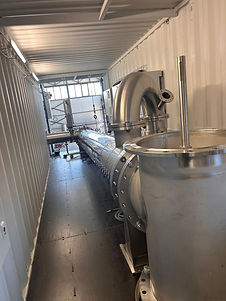
Oxygen-free thermal cracking (the “pyrolysis” stage)
The material is heated in an anaerobic (oxygen-free) environment so polymer chains crack into shorter hydrocarbon molecules without combustion. In the brochure, this is described as operating around 450–650°C, using a sealed, controlled system.
Vapour recovery and condensation
As plastics break down, hydrocarbon vapours are routed through cooling/condensing stages to form a liquid recyclate (a secondary raw material that can be upgraded into fuels/chemicals/polymer feedstocks).
Non-condensable gas capture and internal energy loop
The remaining process gas/syngas is recovered and reused internally to support system energy needs and improve efficiency—reducing dependence on external fuel inputs.
Solid output removal
A small fraction exists as solid inert residue/carbon char (described as non-hazardous/inert in the technical materials and suitable for regulated reuse pathways, depending on permitting and specifications).
Closed-system controls & compliance
The system is designed around closed operation, continuous monitoring, and emission-control measures. Critically, the absence of oxygen prevents combustion, which is why the process is presented as distinct from incineration/energy-from-waste—its primary purpose is material recovery.
Typical outputs (from the technical description)
-
Liquid recyclate: ~63–80% by weight
-
Process gas: ~10–20% by weight (reused internally)
-
Solid inert residue: ~3–8% by weight